



NEVÜ’s 10 Projects Selected for the COP31 YÖK Pavilion
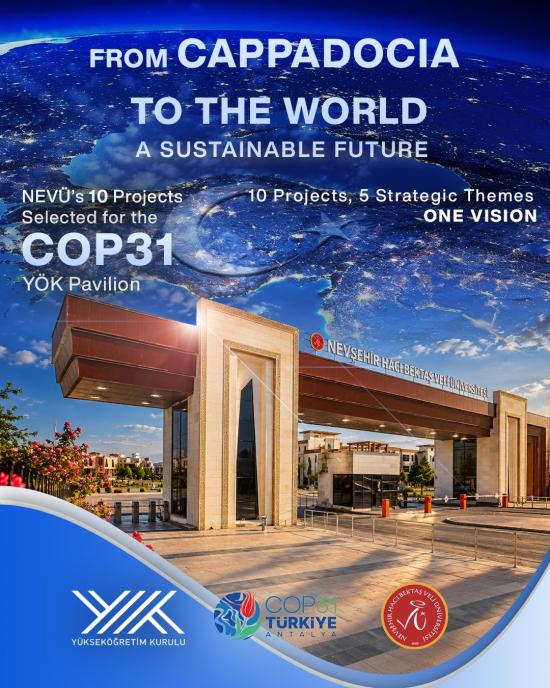
Nevşehir Hacı Bektaş Veli University (NEVÜ) will take part in the Council of Higher Education (YÖK) Pavilion at the 31st Conference of the Parties (COP31) to the United Nations Framework Convention on Climate Change, which will be held in Antalya, Türkiye, from 9 to 20 November 2026. Ten projects submitted by the university under five strategic themes addressing climate, health and quality of life; sustainable campuses and the circular economy; food, agriculture and water security; society, culture and resilience; and energy and climate economics have been selected for inclusion in the pavilion.
NEVÜ Rector Prof. Dr. Semih Aktekin stated that the selection of 10 of the university’s projects submitted to YÖK for COP31 demonstrates the scientific productivity of its academics, their capacity for interdisciplinary collaboration, and their contributions to sustainable development goals. Emphasising that universities are not merely institutions that generate scientific knowledge but also assume important responsibilities as centres of solutions shaping humanity’s shared future, Aktekin highlighted the importance of translating scientific research addressing global challenges, such as climate change, into tangible applications.
Aktekin noted that the university aims to bring Cappadocia’s natural and cultural heritage together with scientific research, transforming the region into a model setting for climate change adaptation, sustainable development and innovative environmental solutions. He expressed his confidence that the selected projects would make valuable contributions to the university, Cappadocia and Türkiye’s sustainable development goals. Congratulating the academics who prepared the projects and the colleagues who contributed to the process, Aktekin stated, “With 10 projects, five strategic themes and a shared vision, we aim to create a scientific impact extending from Cappadocia to the world.”
Ahead of COP31, scheduled to take place in Antalya, Türkiye, from 9 to 20 November 2026, 208 universities across Türkiye were included in the academic participation process coordinated by YÖK. A total of 3,373 applications were submitted by 2,767 participants. Applications were evaluated across various categories, ranging from research, technology and innovation to international academic collaborations, with priority given to key issues such as zero waste, food security, climate-resilient cities, the clean energy transition and resilient healthcare systems.
NEVÜ’s selected projects fall under five strategic themes: Climate, Health and Quality of Life; Sustainable Campus and Circular Economy; Food, Agriculture and Water Security; Society, Culture and Resilience; and Energy and Climate Economics.
Projects on Climate, Health and Quality of Life
The Cappadocia Climate and Health Observatory project, developed with contributions from Prof. Dr. Bayram Deviren and Ethem Yaşar, aims to examine the relationships between climate variables and health indicators in the region and to develop risk maps and early warning mechanisms.
The project titled Climate Change, Dust and Pollen: The Changing Burden of Respiratory and Allergic Diseases in Cappadocia, prepared by Lecturer Dr. Emine Bircan Künkül, focuses on the effects of climatic conditions and air quality on respiratory health.
The project Electrobiochemical Pesticide Detection Biosensor through the Recycling of Orthodontic Wires, developed by Assist. Prof. Dr. Umut Kökbaş, aims to transform discarded orthodontic wires into an innovative technology that can be used for environmental analysis.
Sustainable Campus and Circular Economy
The Circular Food System and Zero-Waste Campus Kitchen Programme, prepared by Prof. Dr. Cem Okan Özer, aims to reduce food waste in campus catering services, increase the use of local and seasonal produce, and recover organic waste.
The Electronic Device Recycling project, developed by Lecturer Ensar Koşatepe, focuses on the recovery and reuse of electronic waste, improving resource efficiency and raising awareness of recycling.
Food, Agriculture and Water Security
The Cappadocia Drought, Food Security and Resilient Agriculture Programme, prepared by Assoc. Prof. Dr. Mualla Keten Gökkuş, aims to develop regional adaptation models to mitigate the effects of drought and water stress on agricultural production.
The project Drought, Green Spaces and Heat in Cappadocia: Satellite-Based Modelling of Climate and Health Risks for Local Residents and Seasonal Tourism, prepared by Lecturer Dr. Emine Bircan Künkül, will investigate the relationships between the loss of green spaces, temperature changes and health risks using satellite data.
Society, Culture and Resilience
The project Modelling the Future with Data from the Past: Resilience Analysis of Different Socio-Political Organisations under Climate Shocks and an Agent-Based Decision Support System, prepared by Assoc. Prof. Dr. Kubilay Atik, aims to examine the resilience of different social and governance structures in the face of climate crises.
The project Beyond Good Intention: Real Conservation Outcomes, prepared by Prof. Dr. Erdoğan Çiçek, focuses on evaluating the tangible and measurable outcomes of nature conservation activities.
Energy and Climate Economics
The project The Pass-Through of Carbon Pricing to Türkiye’s Electricity Market, prepared by Assist. Prof. Dr. Selin Zengin Taşdemir, aims to examine the effects of carbon pricing policies on the electricity market. The study is expected to contribute to the evaluation of energy policies during Türkiye’s transition to a low-carbon economy and to the development of economic mechanisms aligned with climate targets.
Through these 10 projects selected for COP31, NEVÜ aims to bring its work in scientific research, regional development and environmental sustainability to the international stage. In line with its vision, NEVÜ seeks to strengthen collaborations with public institutions, local authorities, the private sector and international research organisations, contributing to Cappadocia’s emergence as a model region for climate action and sustainable development.